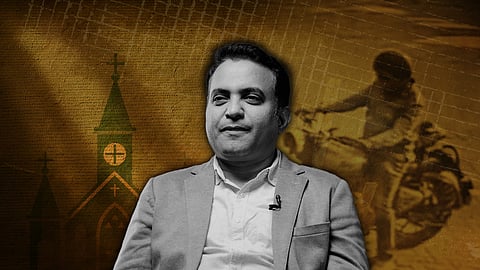
Praveen Pagadala: The life, death, and political afterlife of a Telugu Christian Apologist
Samuel Yellay’s friendship with Christian preacher Praveen Pagadala began in 2018 over an act of violence. A group of Hindu men had set a box of Bibles on fire after assaulting members of a Christian evangelical group, about 200 km from Hyderabad in Telangana. “Some of us thought we should get together and counter such anti-minority communal forces,” Samuel recalled.
Their friendship continued over the years, over church services and activism.
They met one last time on March 23, 2025. Praveen had come to Samuel’s house in Hyderabad to invite him on a trip to Maharashtra.
Samuel, a retired school headmaster, was unwell and did not feel up to a long journey. Instead of travelling to Maharashtra, Praveen changed his plans and set off alone for Rajahmundry on his Royal Enfield. Samuel never learned why.
Praveen died the next day.
His body was found on the morning of March 25, in a trench running along National Highway 16 on the outskirts of Rajahmundry. At first, the police thought he was just another biker on a long ride. Even after learning his identity, they did not quite foresee how quickly grief would spill into suspicion, and suspicion into mobilisation.
Within hours, hundreds of Christians, mostly Dalits, gathered outside the Rajahmundry Government General Hospital, where Praveen’s body was taken. The crowd grew by the hour. People wanted answers: was it an accident, or murder? Was it a hate crime?
For Samuel, the news carried a quieter weight. “My wife often wonders if Praveen would still be with us today if I had gone with him,” he said.
Until his death, Praveen had not been among the most widely recognised Christian preachers in the Telugu states. But he was a familiar figure to those invested in Christian theological discourse, regularly appearing on television to take on Muslim and Hindu religious figures on questions of Sanatana Dharma, Islamic fundamentalism, the Rashtriya Swayamsevak Sangh (RSS), and caste inequality.
Praveen belonged to the Christian Apologetic tradition — a form of structured theological defence that, at least in his case, was shaped by the political churn of contemporary India.
Soon after his death, Praveen’s old speeches began circulating widely online, drawing new audiences and sharpening communal reactions. For many Christians, he became a martyr. Others attacked and mocked him for his critique of Hindu scriptures. YouTube channels latched on to the frenzy of speculation, and Praveen’s death became a participatory true-crime investigation on the internet.
Twenty days later, the police declared the death a drunk driving accident and closed the case.
But by then, many of Praveen’s followers were convinced that the CCTV footage cited by the police concealed a different truth. No forensic report, mobile location data, or eyewitness testimony could puncture their mistrust in the state machinery.
A year on, there is still no single, uncomplicated narrative of Praveen Pagadala’s death. The competing versions of truth that emerged — out of internet debate, street protests, congregations, and the caste, religious, and political dynamics of Andhra Pradesh — have only solidified.
In this five-chapter story, we revisit Praveen’s life and death. Drawing on interviews, post-mortem and forensic reports, and other records, we do not attempt to reinvestigate the case or offer neat answers. Instead, we examine the political and cultural forces that shaped Praveen into a Christian Apologist — and how, in those same circumstances, his death became a conduit for long-simmering anxieties among Telugu Dalit Christians.

Chapter 1: The making of a Christian Apologist
Standing behind a podium marked with a white cross, addressing a Christian gathering, Praveen recites lines from a ‘90s Telugu song.
“Naa gunde pagilinde, padi mukkalayyinde, prati mukkalo nuvve priya (My heart has broken into ten pieces. In every piece, you are there, dear).”
The original version of the song is from the Kannada film A, a cult favourite in Telugu popular culture, and features an intoxicated Upendra wooing a woman.
Praveen’s rendition makes the audience erupt with laughter.
“Only sinners like me would know such a song, not saints like you,” he says, drawing more laughs.
He goes on to narrate how he found Jesus as an aimless young man just out of high school, singing songs of heartbreak while trying to get over a girl.
Years later, he says, a friend dragged him along to a church’s youth fellowship programme, where he was struck by the confidence of the other adolescents who spoke English without effort and played worship songs on the guitar.
He remembers listening to a sermon half-heartedly when the pastor repeatedly said, “God is the light of the world.”
“The pastor then turned to me and said, ‘You are the light of the world,’” Praveen tells the gathering. “I thought to myself, I might have a light with me,” he adds, miming a cigarette in his hand, drawing more laughter. “But how can I be the light of the world?”
Praveen says the words consumed him for days. He withdrew into his room, frantically skimming the Bible until he found Matthew 5:14: “You are the light of the world. A city set on a hill cannot be hidden.”
Across history, the metaphor of being the “light of the world” or a “city set on a hill” has carried particular resonance for oppressed Christian communities. African American churches, for instance, have often invoked it as a mission statement in response to the political and spiritual demands placed on a people emerging from slavery.
Praveen says he read the Bible repeatedly, until he “accepted his sins and surrendered to Christ.”
Praveen was born and raised in Kadapa by his mother, a Dalit Christian. His father, a Muslim, was absent for most of his childhood. Praveen and his elder brother Anthony grew up with their mother and maternal grandfather.
In his talks, Praveen often described a childhood faith that was more habitual than fervent. His mother would sometimes take the boys to local Catholic churches, and every year to the Roman Catholic shrine at Velankanni in Tamil Nadu, where their heads would be tonsured.
“I only wanted to go to church on special occasions like Good Friday,” he would joke, “when they would have a treat, like a Rasna drink.”
It was only after moving to Hyderabad for his undergraduate studies that Christianity became central to his life, following a sermon at a youth fellowship of the Emmanuel House of Worship (EHOW) in Secunderabad. This is where the pastor spoke about being the “light of the world.”
After graduating, Praveen moved to Indore in 2001 to pursue a Master’s in Business Administration (MBA) at Devi Ahilya Vishwavidyalaya.
Around the same time, he began working with Shalom Calvary Church, a Protestant congregation associated with the Church of North India (CNI), run by Reverend JF Wallace. Praveen later married Wallace’s daughter, Jessica, around 2005.
After his death, Praveen was widely described in the media as a pastor. This was not strictly accurate. Police records describe him as a Christian preacher and motivational speaker. But the term that best captures his public role is different.
Praveen was a Christian Apologist.
Christian Apologetics is a branch of Christian theology devoted to explaining and defending the faith against criticism. Historically, influential Apologists such as Justin Martyr (132 AD) and Tertullian (193 AD) were fresh converts, driven by the urgency of belief in hostile environments.
Praveen’s turn to Apologetics unfolded in a similarly charged context, shaped by caste hierarchies, religious polarisation, and the rise of Hindutva politics.
Praveen was part of Sakshi Apologetics Network, founded by his friends George Paul and Jerry Thomas.
The group initially focused on countering controversial Islamic preachers such as Zakir Naik who criticised Christian doctrine. But after 2014, as Hindutva nationalism expanded in south India, its focus began to shift.
“We didn’t choose our opponents,” Praveen said in an interview in January 2024. “Ours was a responsive approach.”