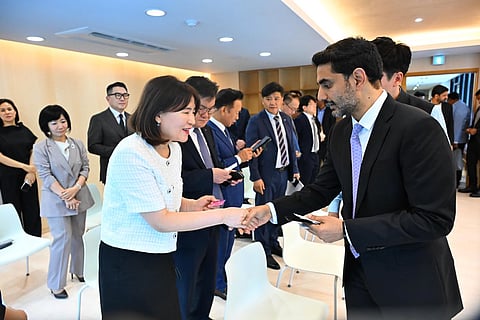

Andhra Pradesh IT and Human Resource Development Minister Nara Lokesh held a series of meetings with South Korean companies during his visit to Seoul, pitching the state as an investment destination and seeking investments in semiconductors, electric vehicles (EVs), electronics, power equipment and startups.
A key focus of the visit was expanding Andhra Pradesh's semiconductor ecosystem. Lokesh met APACT Chief Executive Officer Seong Dong Lee to discuss the company's ₹468-crore Outsourced Semiconductor Assembly and Test (OSAT) facility in Visakhapatnam, approved under the India Semiconductor Mission. The facility is expected to manufacture 96 million semiconductor devices annually. He also proposed a partnership between APACT and the Andhra Pradesh State Skill Development Corporation to train youth in semiconductor assembly, packaging and testing.
Lokesh also invited Seoul Semiconductor to establish a display fabrication facility in or around Sri City. During the meeting, he said Andhra Pradesh had attracted $240 billion in investments over the past 24 months, accounting for 25% of all investments received by India during the period. He added that more than 40 Korean companies, including Kia, LG Electronics and MCNEX, have manufacturing units in the state.
In a separate meeting with SOLUM Group, Lokesh urged the company to expedite work on its ₹338-crore facility for EV charger power modules and automotive electronics at Sri City. He also proposed expanding its operations to include display-related products.
During discussions with Hyundai Mobis executives, Lokesh proposed establishing an EV semiconductor hub in Andhra Pradesh, along with a manufacturing facility for EV components and battery systems near Tirupati or Anantapur. He also suggested setting up an R&D and engineering centre in Visakhapatnam and a Centre of Excellence in collaboration with IIT Tirupati. The minister sought the company's support for research in autonomous driving, Advanced Driver Assistance Systems (ADAS) and smart manufacturing through the state's Ratan Tata Innovation Hub (RTIH).
Lokesh also met representatives of Hyosung Heavy Industries and invited the company to establish a switchgear and power equipment manufacturing or assembly facility near Tirupati or Sri City. He outlined Andhra Pradesh's plans to expand its power transmission network and clean energy infrastructure.
The minister also sought investments in the state's startup ecosystem. Addressing a roundtable organised by the Seoul Business Agency, Lokesh invited Korean startups to participate in RTIH programmes and proposed creating an India-Korea Startup Corridor to facilitate collaboration between startups from both countries. He said the state aims to create 20,000 startups and one lakh jobs over the next five years through RTIH, while also developing a quantum computing and artificial intelligence ecosystem in Amaravati.
During his visit, Lokesh also met executives from Soft-Epi and Shoealls. He invited Soft-Epi to establish a micro-LED display materials hub, an advanced epitaxy centre and a training academy in partnership with IIT Tirupati and the state government. He also urged Shoealls to expedite work on its proposed ₹300-crore footwear manufacturing unit and proposed setting up an R&D and innovation centre in Andhra Pradesh.
In separate meetings with LG Electronics Global CEO Lyu Jae Cheol and LG Electronics India CEO Hong Ju Jeon, Lokesh invited the company to establish an Engineering Centre or Global Capability Centre in Visakhapatnam, develop a components manufacturing ecosystem around Sri City, collaborate on Internet of Things (IoT) and robotics innovation labs, and consider setting up a commercial chiller manufacturing facility in the state.
This article was written by a student interning with TNM.
