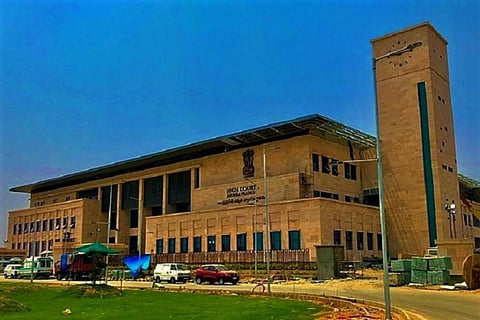

A three-member bench of the Andhra Pradesh High Court will hear the case related to the allotment of house sites to the poor in the Amaravati capital region. The court decided to keep aside other cases related to the state capital and take up hearing on what is called the R5 zone case. It decided that a bench comprising three judges will hear the case. The court adjourned the hearing to July 17.
The R5 zone is a new housing zone for the poor that was carved out by the YSRCP government earlier this year. It includes over 900 acres of land, made up of plots that were earlier part of other zones — including a non-polluting industry zone, town centre zone, educational zone, business park zone etc. — and now converted to the R5 zone. The original master plan had been formulated under the previous Telugu Desam Party (TDP) government led by former Chief Minister Chandrababu Naidu, which had pooled land from farmers and landowners in the region. Those who pooled their lands were promised developed plots in an urbanised capital city. But all development activity was halted after the YSRCP came to power in 2019.
During the hearing on the R5 zone case on July 5, a division bench comprising Justice U Durga Prasad Rao and Justice Venkata Jyothirmayee sought clarity from the state government as to whether the Supreme Court had given permission only for the distribution of house sites to the poor in the R5 zone of the capital region Amaravati or permitted the construction of houses also.
The court had also served notices on Special Chief Secretary Y Srilakshmi, who was made a respondent in a personal capacity, besides the Chief Secretary, the Deputy Secretary, Union Ministry of Housing, Principal Secretaries of Municipal Administration and Urban Development (MAUD) and Revenue, Andhra Pradesh Capital Region Development Authority (APCRDA) Commissioner, Land Allocation Committee, district Collectors of Guntur and NTR districts, and tahsildars concerned.
Petitioners' counsel had requested that the court take up hearing on only the R5 zone petition without linking it with other cases relating to the state capital. The division bench accepted the request.
Ignoring objections of Amaravati farmers and landowners, and the opposition parties, Chief Minister YS.Jagan Mohan Reddy formally launched the distribution of house site pattas on May 26 to 50,793 poor women beneficiaries in an area which was previously earmarked for the development of the state capital in Amaravati. He launched the programme in an area called the R5 zone spread over Guntur and NTR districts.
He said the government would spend Rs 2000 crore for the construction of houses and providing infrastructure in 25 layouts benefiting 23,762 poor women who got house site pattas in 11 layouts in Guntur district and 27,031 women who received the pattas in 14 layouts in NTR district.
On May 17, a Supreme Court bench hearing a batch of Special Leave Petitions (SLPs) filed by the farmers and landowners in Amaravati declined to grant a stay on an earlier order by the Andhra Pradesh High Court, which permitted the state government to allocate housing sites to the economically weaker sections in the R5 Affordable/EWS Housing Zone. However, the apex court also ruled that the rights of beneficiaries of house sites will be subject to the Andhra Pradesh High Court’s final judgment.
In March this year, the state government declared a new zone R5 in Amravati to provide houses to poor people over 900 acres of land. It is part of the land that was previously earmarked for industries, businesses and other commercial purposes in the master plan for the Amaravati capital area.
The move upset the Amaravati farmers’ Joint Action Committee (JAC) which is already protesting the decision of the state government to develop three state capitals instead of just one in Amaravati. The farmers challenged it in the High Court on the grounds that this would change the status of the capital region and affect their interests.
The High Court on May 5 refused to pass interim orders on a petition filed by farmers of Amaravati. The farmers alleged that the allotment house sites were in violation of the master plan. They argued that locals should be allotted the sites after the development of the region.
The government defended its action. It argued that farmers can demand lands assured to them by the government but it has the right to allot land to anybody. The court was told that the government has taken a decision to allot land to the poor.
It was in October last year that the government amended the Amaravati master plan in order to provide houses to poor people over 900 acres of land spread across four villages.
